
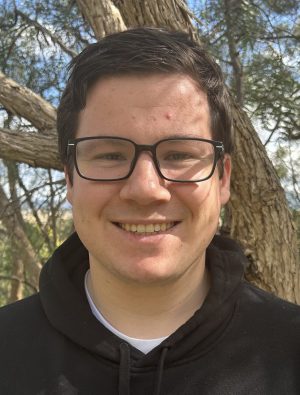
Heath Dimsey
University of Tasmania
I am a current PhD student at the University of Tasmania in the field of applied mathematics under the supervision of Emeritus Professor Larry Forbes and Professor Andrew Bassom. In particular, my branch of applied mathematics looks at how we can model and understand the spatial patterns that form in oscillating chemical reactions. Before starting my Ph.D., I completed both my Bachelor in Science majoring in mathematics and chemistry, and my Honours in mathematics at the University at Tasmania.
Can you give me a quick rundown about the type of mathematics you are studying and its potential impacts for the broader community (think how you would explain your work and studies to others who don’t study maths)
I use applied mathematics to study a type of chemical reactions known as oscillating chemical reactions. These reactions are unique as they allow the formation of spatial patterns. By understanding how and why these reactions can form patterns we can gain important insights into a range of other phenomena. For example, the types of processes that we are working with are believed to be the same that drive lots of chemical processes in in the body as well as disease spread through a population and predator-prey interactions in nature.
How did you get into mathematics/statistics/data science? Was there someone or something that inspired you to this field?
I have loved mathematics since I was a child, and this is largely due to my parents. My mum always made maths into a game and my dad – an electrician – always emphasised the importance of maths in his work. Despite this, I never saw maths as a career or study option. It wasn’t until years 11 and 12 when I had some very passionate maths teachers who opened my eyes to the possible careers and encouraged me to pursue further education in mathematics.
You received a Travel Grant to attend AMSI Summer School 2025. How important was this in terms of your ability to attend, fully participate in the program and meet others studying in similar fields? Do you think it was an advantage to attend the program in-person?
As a student from Tasmania the travel grant was paramount in my ability to attend and it simply would not have been feasible otherwise. Being able to fully participate in the program was very beneficial with some of the most important activities being external to the classes and in-person only. By attending in person, I got so much more out of the AMSI Summer School than I would have been able to from attending online.
What was the most valuable part of the program for you?
For me, the most valuable part of the program were all of the extra, external components. I found the student talks and the careers day particularly valuable. While the course was very beneficial to me, having the opportunity to deliver a talk to a group of like-minded mathematicians in a relaxed setting is an experience I do not often get. Furthermore, the careers day gave me the opportunity to meet potential future employers and reaffirm to me that mathematicians are highly sought after.
In the long-term, what do you think are the benefits of having attended Summer School?
I think the number one long-term benefit of attending the summer school is all the new people I have met. Not only have I met a range of academics at the University of Sydney who are happy for me to work with them in the future, but I have also met and built relationships with the other attendees. It has allowed me to build connections with a range of people who may end up being my colleagues or collaborators.
Summer School included a special Careers Day program which aims to help give students an idea of the kinds of career paths available to maths graduates in industry and private sector research areas. Do you feel better equipped to explore career options in the mathematical sciences after attending AMSI Summer School?
The careers day was a great event and being able to talk to a range of potential future employers made me feel comfortable knowing there were many career outcomes available for me. More importantly, every employer emphasised that even though the type of maths that I do does not directly align with what they find all mathematicians very employable due to their abundance of transferrable skills such as the ability to research, coding experience and problem-solving skills.
What advice would you give to someone who is considering applying for Summer School in 2026? Should they apply and why?
If you’re considering applying for the summer school, apply. The classes alone are worth it but the additional benefits, like building connections with peers and participating in other experiences make it so worth it. I was always scared that I would not be smart enough and I regret not applying to attend in past years for the reason. There is a huge range of experiences and the classes, in my experience, sit somewhere between a third year and honours level course.
What are your current career ambitions in the mathematical sciences sector?
Currently, my ambitions are to be an academic in a split teaching/researching position. I love being able to problem solve research questions but also love teaching mathematics. In an ideal role I would integrate this position with some science communication as this is another area that I am very passionate about.
How did connecting with the community at AMSI Summer School support your experience?
It made the experience more enjoyable in every way. Being able to discuss assignments and classes with other students as well as being able to socialise and plan activities to do in our down time made it a great atmosphere to be a part of.