
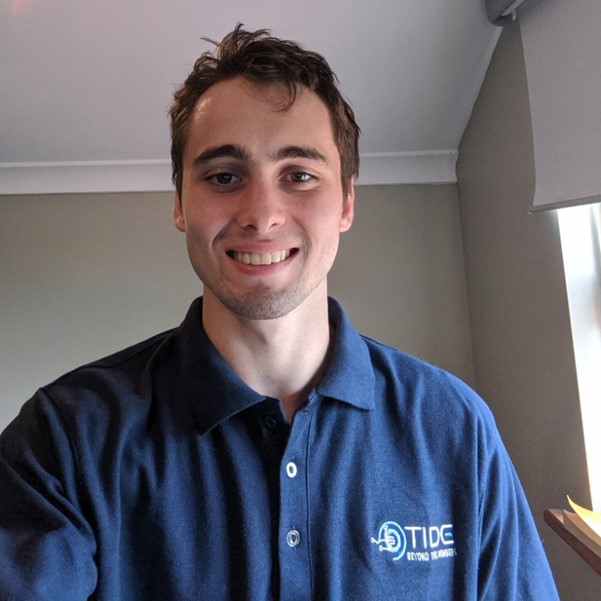
Marcus Dyson
The University of Western Australia
I am a 2nd year PhD student at UWA in the school of Mathematics and Statistics. My Research is in spectral analysis, which in the statistics context, is the analysis of frequency components in a signal. I am conducting this research under the supervision of Thomas Stemler, Ed Cripps, and Lachlan Astfalck as part of the enabling theme of ARC TIDE. Outside of my studies I enjoy training martial arts, playing music, and hanging out with my brothers.
Give me a quick overview of the type of mathematics you are studying, and/or the aims of your research and its potential applications/outcomes (how you would explain your work and studies to friends who don’t study maths?)
My research is on power spectral density (PSD) estimation methods. The PSD tells us the frequencies that contribute most to the total variance (how jumpy) of a system. For example, in oceanography the PSD tells us which frequencies of waves have most of the energy. The problem with PSD estimation is high variance in estimates and bias, where our estimates are distorted. My research looks at how to reduce both, providing a better understanding of phenomena. This has applications in oceanography for understanding the sea state, which allows for better designs of offshore structures.
How did you get into the mathematical sciences? Was there someone or something that inspired you to this field?
Before undergrad I was unsure what I wanted to do. So, I made a spreadsheet that ranked the majors through 3 criteria: what is useful, what am I good at, and what do I like. Math got the highest score. Also, I’ve always been drawn to the power of mathematics, with its large breadth of applications.
Winter School is designed to give students a deeper understanding of their area of research and expose them to others working in different fields/industries. Tell me about your Winter School experience. What was the most valuable part of the program for you?
Winter school was good fun. The most valuable part for me was the opportunity to collaborate and socialize with the lecturers and attendees. These interactions proved very effective at coming up with ideas and learning from those who have been in the field much longer than myself.
What was your main take away/s from AMSI-MATRIX Winter School? Something you learnt? A connection you made? Do you have new ideas for your work/research or see it in a new light?
My main takeaway from the winter school is a greater understanding of modern approaches to tackling NP hard problems. In my previous ignorance I thought many of these problems couldn’t be solved in any reasonable amount of time. I was wrong. I was also very impressed with the continued fraction regression. Definitely gonna enquire more about it.
You received a grant to attend AMSI-MATRIX Winter School. How important was this in terms of your ability to attend, fully participate in the program and meet others studying in similar fields?
I think in person attendance is very important to get the most out of such an event. Often it is the discussions after a talk which cement the ideas. Online this is much harder, and I would not have attended had I not been given a grant.
What advice would you give to someone who is considering applying for Winter School? How would you describe the conference to them?
I think for someone who is going into honours or who has just finished honours I would say that it is a great way to get exposure to many different research directions and meet fellow mathematicians. For research students it is slightly different. Given the constraints on time it is hard to go into depth on topics and since many students further into their research are already quite narrow I would say that the main reason to attend is to get hints or inspiration from another field and to meet fellow mathematicians who may become collaborators in the future.
Where do you want the mathematical sciences to take you? Where do you see yourself in five, ten years time?
I want to do something that I find interesting, apart from that I am open minded. I don’t know where I see myself in 5 to 10 years time. My current time horizon extends only to the end of my PhD.