
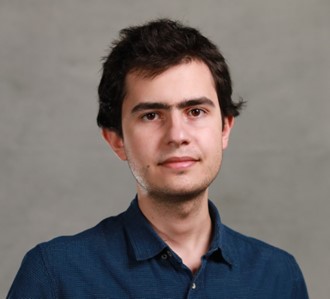
Stephen Catsamas
University of Melbourne
Stephen Catsamas is a PhD student in the School of Physics at the University of Melbourne. His research focuses on exploring new capabilities for monitoring satellites in Earth’s orbit via first-principles physical modelling and analysis. Stephen holds a PhB (Hons) in Physics with a second major in Mathematics from the Australian National University and was a recipient of the Hanna Neumann Prize for First Year Mathematics and the Australian Institute of Physics Prize during his studies. Outside of his PhD, Stephen maintains interest in the application of low-cost electronics to improve the monitoring and ultimately health of our urban and environmental waterways.
Give me a quick overview of the type of mathematics you are studying, and/or the aims of your research and its potential applications/outcomes (how you would explain your work and studies to friends who don’t study maths?)
Currently, I use the mathematics of statistical inference in my day-to-day research. Statistical inference answers the question of how we can make measurements from noisy or uncertain data. I use these techniques to study how well we can measure the temperature of satellites from observations of their infrared emissions. These observations are subject to noise from similar emissions from background dust, foreground telescope emissions, and the inherent quantum nature of these infrared photons and hence observed data differs the idealised emissions of the satellite. By modelling each of these sources of noise, the methods of statistical inference can tell us what the temperature of the satellite is hidden amongst these sources of interference and how confident we can be with that answer. The capabilities I am studing in my research will help satellite operators manage their satellite and understand other satellites around them.
How did you get into the mathematical sciences? Was there someone or something that inspired you to this field?
Since young, the mathematical sciences have always excited me, this has only strengthened as I have continued to learn about them. My passion for mathematics stems from their rigorous uncovering of truth and their ever-expanding applications to address the problems of our physical world.
Winter School is designed to give students a deeper understanding of their area of research and expose them to others working in different fields/industries. Tell me about your Winter School experience. What was the most valuable part of the program for you?
The most valuable parts of my winter school experience were two-fold. Firstly, I was able to learn broadly about field of mathematical optimisation which I hope to apply later on in my research. This broad covering gave me a map to direct me towards the techniques in optimisation appropriate for my research and which I should study in greater depth. Secondly, the winter-school gave the opportunity to network with students and researchers in optimisation. Learning about other’s experiences, journeys, and perspectives on optimisation but also on mathematics and academics mode broadly is always a valuable experience.
What was your main take away/s from AMSI-MATRIX Winter School? Something you learnt? A connection you made? Do you have new ideas for your work/research or see it in a new light?
I left the AMSI-MATRIX Winter School with a recharged energy towards research and towards the mathematical sciences. This energy was recharged through nifty mathematical problems posed in conversation from fellow researchers, through learning to the interesting work of peers, and through exiting frontiers and impactful applications of optimisation presented by lecturers.
You received a grant to attend AMSI-MATRIX Winter School. How important was this in terms of your ability to attend, fully participate in the program and meet others studying in similar fields?
Receiving a grant to attend the AMSI-MATRIX Winter School greatly facilitated my participation. In particular, the on-campus accommodation provided by the grant allowed me to engage with fellow students and researchers outside of the scheduled classes and lectures. Here, meaningful discussions and potential future collaborations were fostered.
What advice would you give to someone who is considering applying for Winter School? How would you describe the conference to them?
I would strongly recommend the Winter School to future applicants. I would advise them to not be overly concerned if their research is not an exact fit for the topic of the winter school. A breadth of learning if the mathematical sciences is always valuable and much of what I took away was not only from the academic program but also from the community built at the winter school. I would therefore describe the conference not only a set of classes and lessons but also a place to foster a passion for mathematics with like-minded peers.
Where do you want the mathematical sciences to take you? Where do you see yourself in five, ten years time?
Over my time conducting research my enjoyment for it has continued to grow. I therefore hope to continue with research in both five and ten years’ time! I hope to continue to learn more mathematics and be able to apply and develop this theory to practical research problems with a real-world impact.
Any other feedback/comments you would like to provide on the travel grant or AMSI-MATRIX Winter School?
I would like to reiterate that I was very grateful to receive an accommodation grant as this helped facilitate my attendance at the Winter School. I found the application process straight forward and relatively easy, however more guidance on an appropriate length for the supervisor’s letter of endorsement would have been aided organising my application; supervisors tend to be very busy and can have limited time to write longer letters of endorseme