
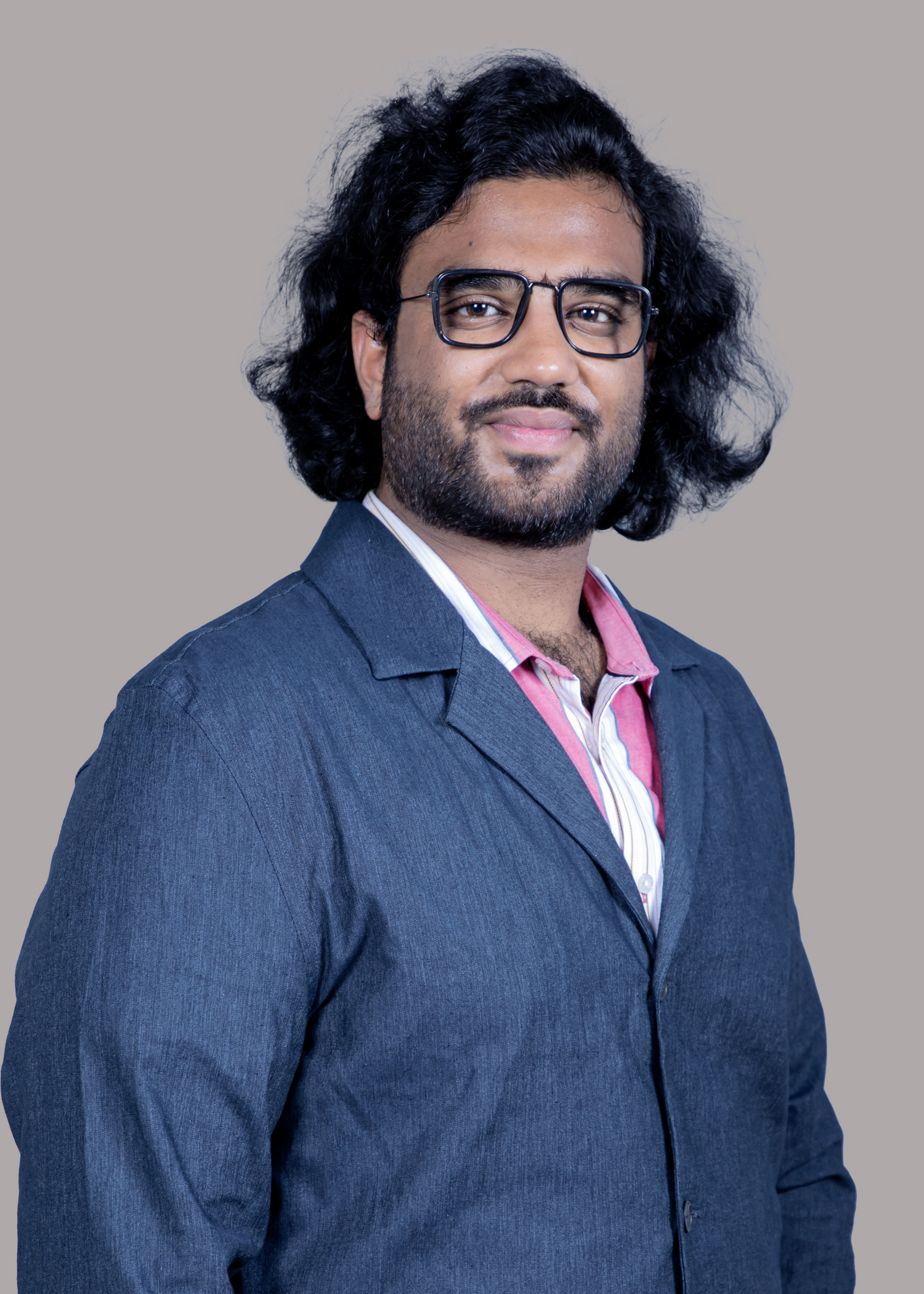
Aditya Raj Dash
Odisha University of Technology and Research, Bhubaneswar, India
Aditya Raj Dash is completing his Integrated Master of Science in Mathematics and Computing at Odisha University of Technology and Research, Bhubaneswar, India, and will graduate in 2025. His primary research interests lie in causal inference and networks, focusing on the theoretical foundations of causal inference and the development of algorithms for observational data in the presence of latent variables and causal feedback loops.
He pursued this research direction during a fellowship at the University of British Columbia, Vancouver, Canada, where he worked on designing a moment-based algorithm for non-linear algebraic causal models. His long-term goal is to apply such methods to complex systems like gene-regulatory and social networks, which often involve intricate interaction terms. Aditya also gained experience at the Strategic Research Unit of the Reserve Bank of India, where he contributed to projects on social network analysis and information diffusion.
Looking forward, he is eager to deepen his exposure to the applications of causal inference and causal representation learning. He aspires to build a career where he can bridge abstract concepts from pure mathematics with their applications in real-world domains.
Give me a quick overview of the type of mathematics you are studying, and/or the aims of your research and its potential applications/outcomes (how you would explain your work and studies to friends who don’t study maths?)
My major is in Mathematics and Computing, where I explore both applied and pure mathematics. I enjoy understanding abstract concepts from pure mathematics and then using them to address problems in applied areas.My primary research focus is on causal inference and networks. In simple terms, causal inference is about understanding not just whether things are related, but whether one thing actually causes another. My work looks at the theoretical foundations of this field and at developing algorithms that can uncover causal relationships from observational data, even when there are hidden (latent) factors or feedback loops in the system. The potential applications of this research are wide-ranging—spanning fields like machine learning, economics, social sciences, neuroscience, and healthcare—where understanding cause-and-effect can lead to better decision-making, predictions, and interventions.
How did you get into the mathematical sciences? Was there someone or something that inspired you to this field?
My interest in the mathematical sciences began with a fascination for problem-solving and logical reasoning during my school years. I was inspired by teachers who encouraged me to look beyond formulas and see the beauty of abstract structures and patterns. Over time, I became drawn to the challenge of applying these abstract ideas to real-world problems, which naturally led me toward mathematics and computing. What continues to inspire me is the balance between creativity and rigor that the field demands.
Winter School is designed to give students a deeper understanding of their area of research and expose them to others working in different fields/industries. Tell me about your Winter School experience. What was the most valuable part of the program for you?
The Winter School was a highly enriching experience that deepened my understanding of new concepts while broadening my perspective beyond my own research. I particularly valued the courses on Emerging Computational Methods and Discrete Applied Mathematics, which aligned well with my background and future research interests. Equally important was the opportunity to connect with fellow participants—sharing ideas, presenting my research to a wider audience, and receiving constructive feedback were truly rewarding. The career development sessions also provided valuable insights into opportunities across academia and industry, making the overall experience both inspiring and impactful.
What was your main take away/s from AMSI-MATRIX Winter School? Something you learnt? A connection you made? Do you have new ideas for your work/research or see it in a new light?
The AMSI-MATRIX Winter School broadened my perspective on my research in causal inference and networks, particularly through exposure to advanced statistical methods and their interdisciplinary applications. I was also able to build meaningful connections with several professors, including Prof. Pablo Moscato, as well as with peers who share similar research interests. The career development sessions were equally valuable, offering insights into pathways beyond academia and demonstrating the versatility of mathematical training in industry. I also gained a lot from the participant talks—both in presenting my own work and learning from others—which strengthened my ability to communicate complex ideas clearly and effectively.
You received a grant to attend AMSI-MATRIX Winter School. How important was this in terms of your ability to attend, fully participate in the program and meet others studying in similar fields?
The grant played a vital role in enabling me to make the most of my AMSI Winter School experience. It gave me the opportunity to participate wholeheartedly in the program, engage with peers and mentors, and take away insights that will support both my research and career development. By easing financial pressures, the grant allowed me to concentrate fully on the academic sessions and networking opportunities the Winter School had to offer.
What advice would you give to someone who is considering applying for Winter School? How would you describe the conference to them?
I would strongly encourage anyone considering the Winter School to apply, as it is a unique opportunity to deepen your knowledge, explore new areas of mathematics, and engage with leading researchers. The program combines high-quality lectures and tutorials with valuable career development sessions, offering insights into both academic and industry pathways. Beyond academics, it fosters an inspiring environment to connect with peers, share ideas, and build lasting collaborations. Overall, I would describe the Winter School as an enriching experience that broadens your perspective and supports both personal and professional growth.
Where do you want the mathematical sciences to take you? Where do you see yourself in five, ten years time?
After completing my Master’s, I plan to pursue a PhD with the long-term goal of securing a faculty position in academia and building my own research group. Through my experiences working with professors and researchers from around the world, I’ve come to see that leading a research group resembles running a startup—seeking funding, mentoring students, publishing impactful results, and fostering collaborations. Coming from a family of teachers, I also value the role of education and aspire to use my PhD as a platform to inspire and guide future generations.
I understand that research is not a short race but a long journey—much like an Olympic marathon or a test match in cricket—demanding persistence, discipline, and resilience alongside skills and knowledge. Wherever my career takes me, I want to cultivate these qualities and grow both personally and professionally. Ultimately, my aim is to make meaningful contributions to my field while also nurturing the people and ideas that will shape the future of science.
Any other feedback/comments you would like to provide on the travel grant or AMSI-MATRIX Winter School?
I am sincerely thankful to AMSI and MATRIX for organizing such a well-structured and rewarding Winter School, and for providing the travel grant that made my participation possible. The support was invaluable in allowing me to fully engage with the program, and I look forward to applying the knowledge and connections gained to advance my future academic and professional pursuits.