
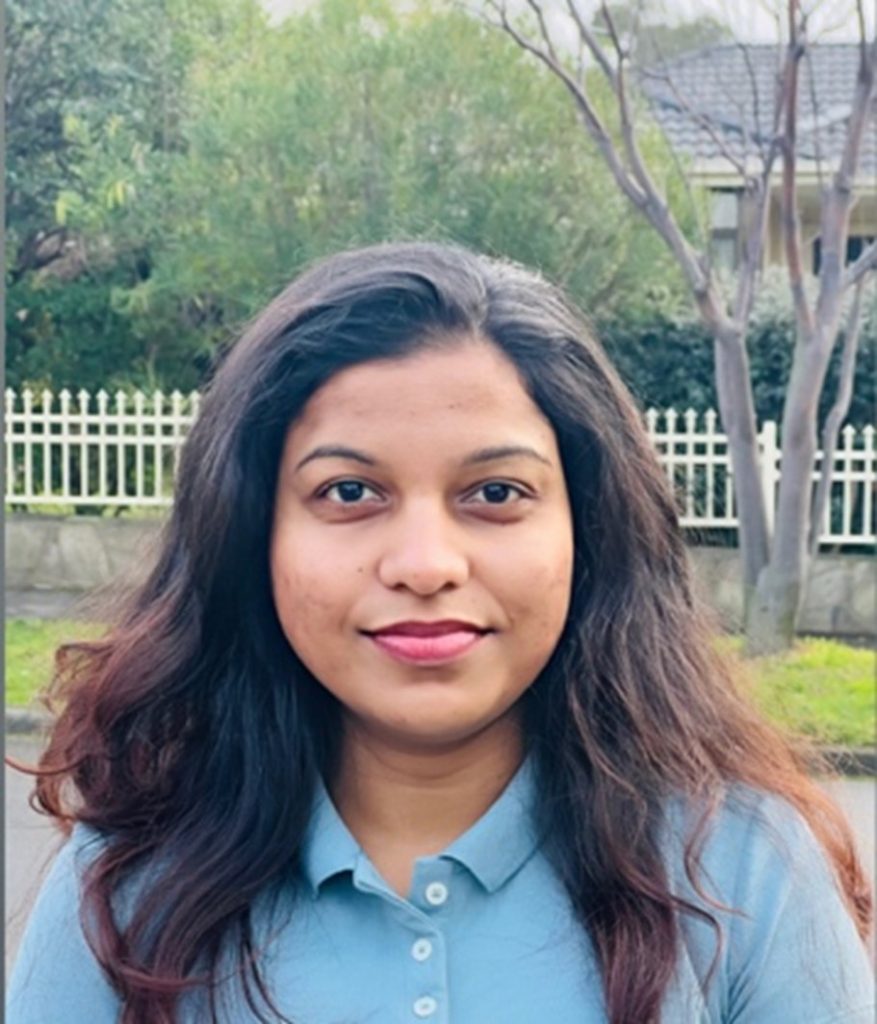
Sandhya Suraweera
RMIT University
I am a PhD student in Operational Research at RMIT University. My research interests lie in optimisation and operations research, with a particular focus on the Nurse Routing and Scheduling Problem for home-based cancer care. I hold a BSc in Industrial Mathematics and an MSc in Operational Research, during which I developed optimisation models for both healthcare and agricultural planning.
In my current PhD work, I am investigating how the nurse scheduling problem can be formulated as a Mixed Integer Linear Program (MILP) and exploring advanced optimisation techniques to improve scheduling efficiency, balance workloads, and enhance patient care outcomes.
My broader research interests include healthcare optimisation, integer programming, and applied analytics in public service sectors, with the aim of bridging the gap between mathematical modelling and real-world decision-making. Alongside my academic research, I have gained professional experience as a Data Analyst in the healthcare sector, where I designed dashboards, reports, and decision-support tools that improved efficiency and service delivery.
Through both academic and professional work, I am motivated to apply mathematical sciences to solve practical challenges and create meaningful impact in healthcare and beyond.
Quick overview of your research
I use mathematics to design smarter ways of scheduling and routing nurses who deliver treatments to patients in their homes. Think of it like planning the best delivery route, but instead of parcels, the “deliveries” are essential health services such as chemotherapy. The aim is to ensure patients are seen on time, while nurses don’t get overworked. This kind of model helps health services use their resources better and provide more reliable care.
How did you get into mathematical sciences?
I have always loved problem-solving, and during my undergraduate studies in Industrial Mathematics I became fascinated by how optimisation could make complex systems work better. My lecturers and mentors in operations research inspired me to see mathematics not just as theory but as a practical tool that could improve healthcare, supply chains, and communities.
Winter School experience
Winter School was a fantastic opportunity to deepen my understanding of optimisation modelling and to see how it applies beyond my immediate research area. The most valuable part for me was the chance to connect with other PhD students, early-career researchers, and experts working on diverse problems. It was eye-opening to see how similar mathematical methods are used across health, energy, transport, and even finance.
Main takeaways
My main takeaway was that optimisation and modelling have a broad impact across industries, and collaboration can spark new research ideas. I gained fresh perspectives on how to extend my nurse scheduling models, for example by incorporating uncertainty and real-time data. I also built connections that I hope will lead to future collaborations.
Importance of the grant
The travel grant was essential in allowing me to attend. Without it, I would have found it difficult to cover the costs of travel and accommodation. The support meant I could fully participate, attend networking events, and focus on engaging with the program rather than worrying about expenses. It also gave me the chance to meet others in person, which is invaluable in building research networks.
Advice for future applicants
I would encourage anyone considering Winter School to apply. It is an excellent way to gain deeper knowledge in your field, explore new applications of maths, and build connections with people facing similar challenges. I would describe it as a mix of lectures, collaborative activities, and networking opportunities, all in a very supportive and inspiring environment.
Future aspirations
In the next five to ten years, I see myself continuing in the field of applied mathematics and healthcare optimisation, either as an academic researcher or in a research-focused role within the healthcare sector. I want to contribute to making health systems more efficient and patient-centred, using mathematical sciences to guide real-world decision-making.
Additional comments
I am very grateful for the travel grant and the opportunity to attend