
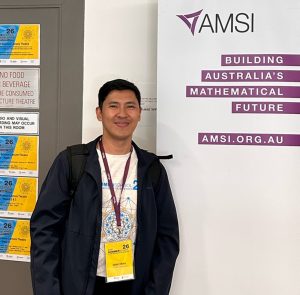
Osbert Bryan Villasis
Macquarie University
Osbert is an international student currently pursuing a Master of Research in Computational Statistics at Macquarie University, where his research focuses on a continuous optimisation–based approach to change-point detection in time-series data. He previously completed a Master’s degree by coursework in Applied Statistics at the same institution and holds bachelor’s and master’s degrees in Mathematics and Applied Mathematics from the Philippines.
Osbert aims to integrate his background in mathematics and statistics to contribute to impactful research, data-driven insights, and educational innovation.
Give me a quick overview of the type of mathematics you are studying, and/or the aims of your research and its potential applications/outcomes
I am currently undertaking a one-year Master of Research program at Macquarie University as preparation for PhD research. For my thesis, I am working on a continuous optimisation–based approach to detecting changes in the behaviour of time-series data. Specifically, my study focuses on offline change-point detection, which has applications across many fields such as healthcare, weather and climate analysis, and economics, where identifying structural changes in data is essential for decision-making.
How did you get into the mathematical sciences? Was there someone or something that inspired you to this field?
From a young age, I already had an interest in mathematics, which was strongly influenced by my aunt, who was a mathematics teacher. Although enrolling in a mathematics degree for my bachelor’s studies happened partly by chance and was not my initial plan, I eventually learned to appreciate its beauty. I was further inspired by my former teachers and the people I worked with through mathematical organisations and at university, which motivated me to pursue mathematics and statistics more seriously.
You received a grant to attend AMSI Summer School. How important was this in terms of your ability to attend, fully participate in the program and meet others studying in similar fields?
Receiving the travel grant was very important, especially as I attended AMSI Summer School in a state different from where I currently reside. The financial support allowed me to fully focus on participating in the program—attending lectures, engaging in activities, and joining additional events such as Careers Day and special and public lectures. It also gave me the opportunity to meet others in similar fields who share the same passion for mathematics and may become future collaborators.
What was the most valuable part of the program for you?
The most valuable part of the program for me was the range of lectures available coupled with hands-on activities and mini-projects, where participants could choose topics to enrol in. This gave me the opportunity to learn areas that are not usually covered in my university degree. In addition, the Careers Day was highly valuable as it helped us understand what skills the job market is looking for, allowing us to reassess and realign our goals when preparing for future job applications.
In the long-term, what do you think are the benefits of having attended Summer School?
In the long term, attending Summer School contributes to greater mathematical maturity by expanding one’s knowledge and way of thinking. It also creates connections that may lead to future collaborations and opens pathways to potential career or further study opportunities.
Summer School included a special Careers Day program which aims to help give students an idea of the kinds of career paths available to maths graduates in industry and private sector research areas. Do you feel better equipped to explore career options in the mathematical sciences after attending AMSI Summer School?
As an international student, there may be some limitations on the jobs I can apply for in Australia. However, the Careers Day provided valuable insights into the key skills industries are looking for—particularly strong mathematical and coding skills, alongside good work ethic and transferable skills. It also reinforced the idea that graduates in mathematics and statistics are not limited to academia, as there are many opportunities available in industry and applied research.
What advice would you give to someone who is considering applying for Summer School in 2027? Should they apply and why?
Do not just consider it—go for it. I would highly recommend applying. It is worth your summer, not only for learning advanced mathematics but also for meeting new people, building friendships, and forming meaningful academic and professional connections.
What are your current career ambitions in the mathematical sciences sector?
I aim to integrate my background in mathematics and statistics to contribute to impactful research, data-driven insights, and educational innovation.
How did connecting with the community at AMSI Summer School support your experience?
Being part of the AMSI community made the learning experience more engaging and less isolating. Discussions outside formal lectures with peers helped clarify concepts and deepen understanding. Connecting with other AMSI students also allowed me to learn about their current research projects and gain insights into future study and collaboration opportunities. Beyond academics, sharing meals and conversations about hobbies and interests created meaningful memories and was one of the highlights of the experience.
Any other feedback/comments you would like to provide on the AMSI Travel Grant or AMSI Summer School 2026?
I am very grateful to AMSI for providing the travel and accommodation grant. I would also like to commend the AMSI administration and the local organising committee for preparing such a well-structured and enriching program. You made our summer both productive and memorable. I hope this program continues to support students in the mathematical sciences by providing learning opportunities with experienced lecturers and researchers, while fostering strong connections for the advancement of mathematics in the modern world. As a small suggestion, the organisers might consider offering a few invitational excursion or social activities in the future, to give participants a chance to take a breather, recharge, and get to know more each other alongside the program’s intensive academic schedule.