
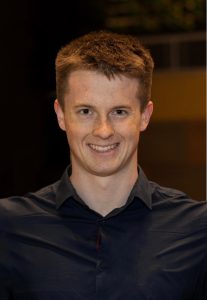
Kyan Percevault
Adelaide University
In 2025, Kyan completed his Bachelor of Mathematical Sciences at the University of Adelaide. He majored in statistics and applied mathematics, and he loved completing courses in applied probability, computational Bayesian statistics, mathematical statistics and topology. At the 2026 AMSI summer school, Kyan studied “Mathematical Optimisation Theory and Applications” and “Linear and Nonlinear Elliptic and Parabolic Partial Differential Equations”.
Kyan has also completed two undergraduate research projects. Through the AMSI vacation research program he studied whether machine learning can replace traditional parameter inference algorithms in Hidden Markov Models. He has also studied time-varying Thompson sampling alternatives for remote state estimation through the University of Sydney. In 2026, he is starting a Master of Research at the Adelaide University under the supervision of Dino Sejdinovic.
Give me a quick overview of the type of mathematics you are studying, and/or the aims of your research and its potential applications/outcomes
My masters project is in Gaussian processes, which is useful to quantify uncertainty in a function learnt from data. When the number of data points is high, using Gaussian processes is computationally expensive, so we instead use approximations. My research looks into how kernel methods (e.g. using Reproducible Kernel Hilbert Spaces) can be used to gain new approximation techniques and analyse how good existing ones are.
How did you get into the mathematical sciences? Was there someone or something that inspired you to this field?
Throughout school I always loved maths. I loved how there are objective truths, and yet there is so much creativity to get to the right conclusion. I have always found this super intellectually stimulating.
You received a grant to attend AMSI Summer School. How important was this in terms of your ability to attend, fully participate in the program and meet others studying in similar fields?
The travel grant was definitely necessary. Without it I wouldn’t have been able to participate as the financial cost would be too high. However, being able to participate in-person was extremely important, as connecting with peers and going to lectures allowed me to stay motivated and learn much more effectively.
What was the most valuable part of the program for you?
For me, the most valuable part of the program was being able to learn so much at a level above the typical undergraduate course. My optimisation course was great to gain further knowledge in an area that I find super interesting, while the PDEs course was great to see a completely new set of techniques.
In the long-term, what do you think are the benefits of having attended Summer School?
It was great to extend my professional network and make friends in completely different areas of maths. It was also great to try a subject which is different from the ones I usually do, as I could get a completely new perspective.
Summer School included a special Careers Day program which aims to help give students an idea of the kinds of career paths available to maths graduates in industry and private sector research areas. Do you feel better equipped to explore career options in the mathematical sciences after attending AMSI Summer School?
Yeah I do feel more equipped. It was great to hear from ASD about some defence opportunities. Also, I didn’t know that companies like Biarri exist, which focus exclusively on optimisation and hire a lot of mathematics students.
What advice would you give to someone who is considering applying for Summer School in 2027? Should they apply and why?
If you are thinking about applying, you definitely should! It was a great opportunity to learn heaps of interesting mathematics, and there was a really nice culture with lots of different people there but all were happy to meet new people and chat about anything.
What are your current career ambitions in the mathematical sciences sector?
I think I will see whether I enjoy research through my masters, and potentially do a PhD but eventually I want to go to industry. I’m not sure exactly what I want to do though, maybe data science?
How did connecting with the community at AMSI Summer School support your experience?
It was great to chat with people about the subjects we were doing and the sort of stuff we were learning about. But it was also really nice to talk about other things, like different postgraduate projects and life outside of maths.
Any other feedback/comments you would like to provide on the AMSI Travel Grant or AMSI Summer School 2026?
Thanks for the great program!