
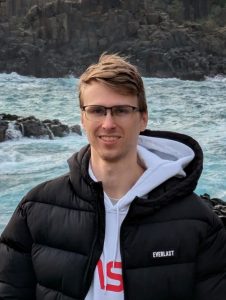
Alexander Bednarek
The University of Sydney
Alexander Bednarek completed a Bachelor of Advanced Mathematics (Honours) at the University of New South Wales in 2022. Since 2023 he has been pursuing a Doctor of Philosophy (Science) at the University of Sydney under the supervision of Professor Zhou Zhang.
1. Give me a quick overview of the type of mathematics you are studying, and/or the aims of your research and its potential applications/outcomes (how you would explain your work and studies to friends who don’t study maths?)
My research has two elements, the objects that I study and the various tools I use to do so. Firstly, the objects which I study, Kahler manifolds, are high-dimensional, geometric shapes with nice structure. These appear in a wide range of areas in physics.
Secondly, the main tool I use is called the Ricci flow and it deforms these Kahler manifolds according to their curvature, smoothing them out over time, in an analogous way to how the heat equation controls how heat dissipates throughout different materials. This process is often able to find a canonical underlying geometric structure to the manifold, however, singularities frequently appear and it is a significant technical challenge, and the goal of my research, to understand how to handle them.
2. How did you get into the mathematical sciences? Was there someone or something that inspired you to this field?
From a young age, I have always had a natural inclination and curiosity towards mathematics. Mathematics seemed to be special in the sense that answers were either true or false and could be determined entirely through logical reasoning. Additionally, the pleasure in solving a difficult problem or learning of an alternate, short or elegant solution really grew my interest.
While in school I was inspired by and would frequently watch the videos of Numberphile, 3Blue1Brown, and Eddie Woo.
3. The Winter School is designed to give students a deeper understanding of their area of research and expose them to others working in different fields/industries. Tell me about your Winter School experience. What was the most valuable part of the program for you?
The most valuable part of the Winter School was certainly the content delivered in the lectures. I hadn’t had much prior experience with cohomogeneity-1 group actions, so it was interesting to see how one can reduce the Einstein equation to some ODEs. Additionally, it was really helpful to see an explanation of all the asymptotic models used in the study of gravitational instantons and the many examples in Prof. Sun’s lectures.
4. What was your main take away/s from AMSI Winter School? Something you learnt? A connection you made? Do you have new ideas for your work/research or see it in a new light?
My main take-aways from the Winter School were to try to broaden my knowledge in research fields adjacent to my own and to get a better feel of working with examples or specific constructions. I also have several new ideas for my research based on discussions with other participants.
5. What surprised you most about Winter School?
I was surprised that there were many international participants and that the mathematics standard at the Winter School was quite high.
6. What is the importance of in-person communication at an event like Winter School?
It is difficult to form good relationships and work together with people you have never met in person. Many of the participants will, undoubtedly, begin working together and collaborating on research due to the Winter School, and these connections will propagate to later in life.
7. You received a grant to attend AMSI Winter School. How important was this in terms of your ability to attend, fully participate in the program and meet others studying in similar fields?
It was very important since I wouldn’t have gotten as much out of the Winter School if I wasn’t able attend in person. In particular, being able to talk with the lecturers and other students about the content and each other’s research was very beneficial.
8. What advice would you give to someone who is considering applying for Winter School? How would you describe the conference to them?
I would encourage applying if the Winter School is closely related to your area of study. You will be able to meet and have some time talking to other students with similar research interests, which can sometimes be difficult in Australia, and have some exposure to modern mathematical research through the lecture content. There is a good balance between the lectures and other activities.
9. Tell us about a moment that changed a preconceived idea about your field?
In the many discussions I had with a particular participant, we found an interesting research problem I hadn’t considered before and may require some non-standard techniques. He also showed me a counterintuitive example in relation to this problem.
10. Where do you want the mathematical sciences to take you? Where do you see yourself in five, ten years time?
I hope to have a permanent position in academia at some university or research institute. Otherwise, I see myself working in quantitative trading.
11. Any other feedback/comments you would like to provide on the travel grant or AMSI Winter School?
Overall, it’s a good opportunity for graduate students to learn some mathematics from an active research area and meet fellow students with common interests.