
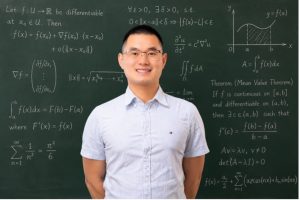
An Ky Duy Nguyen (Kyan)
La Trobe University
Kyan Duy Nguyen is a PhD student in Pure Mathematics at La Trobe University. His research lies in differential and Riemannian geometry, with a particular focus on hidden symmetries of geometric spaces, Killing tensors, and the geometry of symmetric and homogeneous spaces.
His PhD research investigates the decomposability of quadratic Killing tensors on Riemannian symmetric spaces. In particular, he studies whether higher-order conserved quantities associated with geodesic motion represent genuinely new hidden symmetries or can instead be constructed from the classical symmetries of the underlying space. His work combines differential-geometric and Lie-theoretic methods with exact computer algebra.
Kyan’s broader mathematical interests include Lie theory, geometric analysis, integrable systems, curvature, topology and mathematical physics. Attending the AMSI Winter School in Geometric Analysis allowed him to broaden his knowledge, engage with advanced research beyond the immediate scope of his PhD, and connect with students and researchers from Australia and overseas.
Give me a quick overview of the type of mathematics you are studying, and/or the aims of your research and its potential applications/outcomes (how you would explain your work and studies to friends who don’t study maths?)
I study differential geometry, which is broadly the mathematics of curved spaces. More specifically, I am interested in understanding the symmetries of geometric spaces, including symmetries that may not be immediately visible.
My PhD research concerns mathematical objects called quadratic Killing tensors on Riemannian symmetric spaces. Killing tensors correspond to quantities that remain constant as an object moves along the natural straightest possible paths, or geodesics, of a curved space. In this sense, they reveal hidden information about the geometry and motion within that space.
The main question I investigate is whether these hidden symmetries are genuinely new or whether they can always be constructed from the ordinary symmetries of the space, represented by Killing vector fields. An informal way to describe this is that I am trying to determine whether complicated hidden symmetries are built entirely from simpler, visible ones.
My research combines differential geometry, Lie theory, representation theory and exact computer algebra. Although it is primarily theoretical, this area is connected with integrable systems, differential equations, mechanics and mathematical physics, where conserved quantities are important for understanding motion and solving equations.
How did you get into the mathematical sciences? Was there someone or something that inspired you to this field?
My interest in mathematics developed gradually through my university studies. I was initially attracted to the logical structure of mathematics and the satisfaction of understanding not only how a method works, but why it must work.
As I progressed, I became particularly interested in geometry because it provides a way to understand spaces through both visual intuition and rigorous abstract reasoning. I was fascinated by how questions about curvature, motion and symmetry could be translated into algebraic structures and differential equations.
My studies in differential geometry, Lie groups and homogeneous spaces eventually led me to research homogeneous geodesics during my Master’s degree. In that work, I studied how geodesic motion on a Lie group can be translated into dynamical equations on its Lie algebra. That experience showed me how closely geometry, algebra and dynamics can interact, and it played an important role in leading me towards my current PhD research on Killing tensors and hidden symmetries.
My lecturers, supervisors and the mathematicians I have met throughout my studies have also been important sources of encouragement. Their example has shown me that mathematics is not simply a completed body of knowledge, but a living and collaborative discipline with many fundamental questions still open to investigation.
Winter School is designed to give students a deeper understanding of their area of research and expose them to others working in different fields/industries. Tell me about your Winter School experience. What was the most valuable part of the program for you?
The Winter School was an academically rich and personally rewarding experience. It gave me a broader and more structured understanding of geometric analysis, which lies at the intersection of differential geometry, differential equations, global analysis and mathematical physics. The programme introduced topics including Einstein manifolds, geometric flows, level-set geometry and analytic methods for studying geometric equations.
Professor Christoph Böhm’s course on cohomogeneity-one Einstein manifolds was particularly valuable to me because it connected closely with my research interests in homogeneous spaces, group actions, symmetries and Killing fields. I appreciated how the lectures developed progressively from homogeneous geometry and orbit structures to cohomogeneity-one spaces and the differential equations governing their geometry. It was fascinating to see how the structure of a space directly influences the equations defined on it.
Professor Song Sun’s course on the geometry of Einstein metrics was also extremely rewarding. The material was deep and technically advanced, but his expertise and insight gave me valuable exposure to ideas at the forefront of geometric analysis.
The most valuable part of the programme was gaining a clearer picture of how different areas of geometric analysis fit together. It encouraged me to look beyond the immediate boundaries of my PhD project and consider techniques and perspectives that may influence my future work.
What was your main take away/s from AMSI Winter School? Something you learnt? A connection you made? Do you have new ideas for your work/research or see it in a new light?
One of my main takeaways was a stronger appreciation of the relationship between symmetry, topology, curvature and differential equations. The courses demonstrated that the equations appearing in geometry are not independent of the spaces on which they are defined. The topology and symmetry of a space can strongly influence the form of those equations, the conditions imposed on their solutions and the techniques available for analysing them.
This perspective is directly relevant to my research. I normally approach Killing tensors through differential geometry, Lie theory and algebraic computation. The Winter School encouraged me to think more broadly about how tools from geometric analysis, Einstein geometry and cohomogeneity-one geometry might interact with questions concerning hidden symmetries and integrability.
The participant talks were another important part of the programme. They allowed me to learn about the research of students from many different institutions and mathematical backgrounds. These presentations helped me identify areas that I would like to study further and possible points of contact for future conversations or collaboration.
I also formed valuable professional and personal connections with Honours, Master’s and PhD students at similar stages of their academic journeys. Meeting both domestic and international participants gave me a stronger sense of belonging to a wider mathematical community.
What surprised you most about Winter School?
What surprised me most was the strength of the community that developed during the programme. I expected the Winter School to be academically valuable, but I did not expect to connect with so many like-minded students in such a short time.
The participants came from different universities, countries, research areas and levels of study, from Honours students beginning their research journeys to more advanced PhD candidates. Despite these differences, people were open, welcoming and genuinely interested in learning about one another’s work.
I was especially pleased to meet and network with four Vietnamese international participants. It was meaningful to connect with other Vietnamese students pursuing advanced study and research in mathematics. We were able to share our academic experiences, discuss the challenges and opportunities of studying internationally, and broaden both our professional and personal networks.
The experience changed my perception of specialised mathematical research as potentially isolating. It showed me that even when our individual research topics are highly focused, we remain part of an active, supportive and collaborative community.
What is the importance of in-person communication at an event like Winter School?
In-person communication is extremely important at an intensive academic programme such as the Winter School. Advanced mathematical material can be difficult to understand from written notes or recordings alone. Being able to ask a lecturer a question immediately, discuss an unclear point with another participant or work through an idea together can make the material much more accessible.
Many of the most valuable conversations occurred outside the formal lectures. Discussions during meals, networking breaks and social events provided opportunities to learn about other participants’ research in a natural and relaxed setting. These conversations often revealed shared interests and possible mathematical connections that may not have emerged during a formal online meeting.
Meeting face to face also helps establish stronger and more genuine professional relationships. After spending two weeks learning and discussing mathematics together, I now feel much more comfortable remaining in contact with other participants, exchanging ideas and potentially exploring future collaborations.
You received a grant to attend AMSI Winter School. How important was this in terms of your ability to attend, fully participate in the program and meet others studying in similar fields?
The travel grant was extremely important in enabling me to attend and participate fully in the Winter School. Travelling interstate and covering accommodation and associated expenses for a two-week programme can place a substantial financial burden on a PhD student.
The grant reduced this burden and allowed me to focus on the academic programme rather than the financial cost of attending. It enabled me to participate throughout the full two weeks, including the lectures, participant presentations, professional-development sessions, networking opportunities and social activities.
The support also made it possible for me to stay close to the University of Queensland campus. This was important because it allowed me to engage fully with the programme each day and spend time with other participants outside the scheduled sessions. Those informal interactions were a significant part of the academic and networking experience.
AMSI’s travel grants are intended to help students and early-career researchers attend in person and develop their skills, networks and research connections. In my case, the grant achieved precisely that, and I am very grateful for the support.
What advice would you give to someone who is considering applying for Winter School? How would you describe the conference to them?
I would strongly encourage students to apply, even when not every course appears to be directly connected with their current research. The Winter School is an intensive but highly rewarding opportunity to learn advanced mathematics from leading researchers, gain exposure to unfamiliar areas and develop a broader understanding of the mathematical sciences.
I would recommend doing some preparation beforehand, particularly for courses outside one’s immediate area. Reviewing the assumed background and reading introductory textbooks or lecture notes can make it easier to follow the more advanced lectures and engage meaningfully with the material.
I would also encourage participants to make full use of the opportunities beyond the classroom. Speak with lecturers, ask other students about their work, attend the social events and participate actively in informal discussions. The lectures are central to the experience, but the conversations and relationships formed during the programme can be equally valuable.
I would describe the Winter School as both an advanced learning programme and an introduction to a wider research community. Participants should arrive prepared to learn, but also willing to meet people, exchange ideas and explore mathematics beyond their existing interests.
Tell us about a moment that changed a preconceived idea about your field?
A moment that changed my perspective occurred during Professor Böhm’s lectures, when the geometry of a cohomogeneity-one manifold was translated into a structured system of differential equations.
Before the Winter School, I understood that geometry and differential equations were closely related, but I often approached them as different components of a problem. The lectures made their interaction much more concrete. The symmetry group, orbit structure and topology of the space directly determined the form of the equations and the boundary conditions that their solutions had to satisfy.
This helped me see geometric analysis as a more unified subject. Geometry does not simply provide a setting in which equations are studied; it actively shapes those equations and determines what kinds of solutions are possible.
It also encouraged me to reconsider my own work. Rather than viewing Killing tensors solely as algebraic or differential-geometric objects, I now see greater potential for examining how they interact with analytic structures, equations of motion and the broader geometry of the spaces on which they are defined.
Where do you want the mathematical sciences to take you? Where do you see yourself in five, ten years time?
Over the next five years, I hope to complete my PhD, publish the main results of my research and continue developing my expertise in differential geometry, Lie theory, geometric analysis and integrable systems. I would like to undertake postdoctoral research and work with mathematicians whose perspectives and expertise complement my own.
In the longer term, I hope to develop an independent research programme in Pure Mathematics centred on the geometry of symmetry, curved spaces and integrability. I am particularly interested in structural questions connecting curvature, topology, Lie theory, conserved quantities and mathematical physics.
I would like my career to combine research, teaching and collaboration. Alongside contributing meaningful mathematical results, I hope to support and mentor students as they develop their own understanding and confidence. My current teaching and academic-support work has shown me how rewarding it is to help students overcome difficulties and discover that they are capable of engaging with challenging mathematics.
In five to ten years, I hope to be an active member of the international differential-geometry community, conducting independent research, collaborating across institutions and contributing to the education and development of future mathematicians.
Any other feedback/comments you would like to provide on the travel grant or AMSI Winter School?
I am very grateful to AMSI, the University of Queensland and the programme organisers for providing the travel grant and delivering such a valuable Winter School.
The academic programme was of a very high standard, and the lecturers brought considerable expertise and insight to their courses. The participant talks, career-development sessions and social activities complemented the lectures well and created a balanced experience.
The event administration was clear and efficient, and the AMSI and UQ staff were approachable and helpful throughout. The campus facilities and accommodation were well suited to the programme. The catering was also excellent: the food was generous, plentiful, varied and consistently delicious.
One possible improvement would be to provide participants with a short list of recommended textbooks, introductory lecture notes or preparatory resources before the programme. Although the courses worked well for me, students entering geometric analysis from different mathematical backgrounds might benefit from additional guidance about how to prepare and get up to speed with the advanced lectures.
Overall, the Winter School broadened my mathematical perspective, strengthened my confidence in undertaking independent research and introduced me to a welcoming network of students and researchers. I greatly appreciate the financial support that made my full participation possible.