
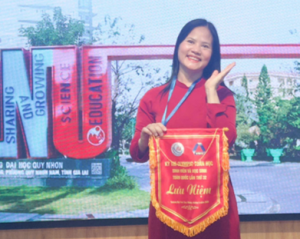
Dr. Nguyen Thi Kim Son
Hanoi University
I received my PhD in Mathematical Analysis from VNU University of Science in late 2025. I am currently a lecturer and researcher at Hanoi University (HANU). My core research focuses on Several Complex Variables, specifically the geometric and asymptotic boundary behavior of domains admitting non-compact automorphism groups, the dynamics of Pinchuk scaling sequences, models of domains with Levi corank 1, and boundary estimates of the squeezing function and generalized Kobayashi metrics.
Give me a quick overview of the type of mathematics you are studying, and/or the aims of your research and its potential applications/outcomes (how you would explain your work and studies to friends who don’t study maths?)
My field of research is Several Complex Variables and Complex Geometry. In high school, we learn about real functions defined on a 1D line or 2D plane. In my research, we study functions of multiple complex variables (z∈C^n). When extending to higher complex dimensions, the geometry and smoothness of a domain’s boundary fundamentally dictate how functions behave on its interior.
Specifically, my doctoral thesis investigated how complex domains deform under infinite continuous symmetries (non-compact automorphism groups) using the Pinchuk scaling method. To explain this to non-mathematicians: imagine taking a complex, high-dimensional curved shape and zooming in infinitely close to its boundary point. Scaling methods allow us to “stretch” and transform this complicated boundary into a much simpler, highly symmetric model domain (such as a unit ball or a Levi corank 1 model). I focus on calculating boundary estimates for the squeezing function σ_Ω (z)and Kobayashi metrics, which measure how faithfully a localized geometric shape can be mapped into a standard ball without distortion. These geometric invariants provide fundamental principles for understanding manifold structures, curvature behavior, and high-dimensional geometric landscapes.
How did you get into the mathematical sciences? Was there someone or something that inspired you to this field?
My passion for mathematics grew during my undergraduate analysis courses, drawn to their logical rigor and abstract structures. I was captivated by the geometric beauty of complex analysis and wished to understand how analytical tools reveal high-dimensional truths. This led me to pursue a PhD at VNU University of Science under Assoc. Prof. Ninh Văn Thu, solidifying my commitment to research and higher education.
Winter School is designed to give students a deeper understanding of their area of research and expose them to others working in different fields/industries. Tell me about your Winter School experience. What was the most valuable part of the program for you?
Having recently completed my PhD, participating in AMSI Winter School 2026 was an exceptionally inspiring intellectual journey. The most valuable aspect of the program was its deep focus on Geometric Analysis, bridging pure complex variables with Riemannian/Kähler geometry and geometric partial differential equations. Attending advanced lecture series gave me a new perspective. I was able to observe direct parallels between boundary estimates of invariant metrics (like the Kobayashi metric) in pure analysis and global curvature behavior or metric flows on complex manifolds.
What was your main take away/s from AMSI Winter School? Something you learnt? A connection you made? Do you have new ideas for your work/research or see it in a new light?
My main takeaway was seeing my doctoral research in the broader context of Geometric Analysis. Scaling techniques and squeezing invariants are not just abstract tools for classifying complex domains; they share deep structural connections with geometric PDEs and metric geometry. During the school, I connected with early-career researchers and faculty across Australia and international institutions, laying the groundwork for future projects that bridge complex analysis with modern geometric analysis.
What surprised you most about Winter School?
I was most surprised by how seamlessly several complex variables and global geometric analysis interact. I initially assumed there would be a technical divide between local boundary behavior and global Riemannian structures. However, interactive sessions showed that concepts like pseudoconvexity, peak functions, and boundary scaling share foundational links with complex Monge–Ampère equations, Ricci curvature, and Kähler geometry.
What is the importance of in-person communication at an event like Winter School?
In-person communication is indispensable for mathematical research. While online talks convey technical facts, spontaneous whiteboard discussions, face-to-face debates over proofs, and casual coffee break chats spark real innovation. Being physically present allowed us to discuss career pathways, and build lasting professional trust.
You received a grant to attend AMSI Winter School. How important was this in terms of your ability to attend, fully participate in the program and meet others studying in similar fields?
The AMSI Travel and Accommodation Grant was crucial for my participation. As an Early Career Researcher from Vietnam, international travel and accommodation costs present a major logistical challenge. The grant covered my travel and on-campus accommodation, allowing me to focus entirely on the academic activities and engage fully with peers throughout the event.
What advice would you give to someone who is considering applying for Winter School? How would you describe the conference to them?
I strongly encourage all PhD students and early-career researchers to apply. Do not hesitate if a Winter School topic seems slightly outside your immediate research area. Mathematics is deeply interconnected, and exposing yourself to neighboring fields in geometric analysis or differential geometry will enrich your primary research in unexpected ways. I would describe AMSI Winter School as a supportive, high-energy environment where top researchers and enthusiastic students learn collaboratively.
Tell us about a moment that changed a preconceived idea about your field?
During my PhD studies, I considered Pinchuk scaling and squeezing estimates purely as abstract machinery for local complex geometry. During a workshop session at Winter School, I realized that the geometric bounds we prove for squeezing functions σ_Ω (z) near boundary points directly mirror the global invariant properties and curvature behavior of Kähler–Einstein metrics. That realization completely reframed my perspective: pure complex analysis is a vital foundational component of modern geometric analysis.
Where do you want the mathematical sciences to take you? Where do you see yourself in five, ten years time?
In five to ten years, I aim to establish myself as a researcher and lecturer at Hanoi University, building a strong bridge between complex analysis and geometric analysis.
Any other feedback/comments you would like to provide on the travel grant or AMSI Winter School?
I extend my sincere gratitude to the AMSI Winter School committee, organizers, and sponsors for granting me this opportunity. The program was exceptionally well organized and plays a vital role in supporting early-career researchers from diverse global backgrounds.