
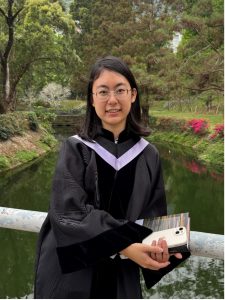
Yanmei Su
The Chinese University of Hong Kong
Yanmei is an MPhil student in Mathematics at The Chinese University of Hong Kong. She is still finding her footing in geometric analysis, with a particular interest in general relativity. She is fascinated by how mathematics can help us make sense of the physical world. Having previously participated in an exchange programme in the UK during her undergraduate studies, this was her second academic experience abroad. Outside mathematics, she enjoys watching films and listening to podcasts. She hopes to pursue a PhD in mathematics and continue growing as a researcher.
Give me a quick overview of the type of mathematics you are studying, and/or the aims of your research and its potential applications/outcomes (how you would explain your work and studies to friends who don’t study maths?)
Recently, I have been studying a survey paper on the Einstein constraint equations. Roughly speaking, these equations describe the conditions that initial data must satisfy before one can study how a gravitational system evolves over time. Although the problem originates in physics, much of the mathematics takes place on curved geometric spaces called Riemannian manifolds.
One question that interests me is whether two existing solutions can be combined to produce a new one. This idea is known as a gluing method, and understanding when and how such constructions are possible is an active area of research. During my MPhil, I am learning about these techniques and, if possible, hope to explore gluing methods in the presence of boundary conditions.
How did you get into the mathematical sciences? Was there someone or something that inspired you to this field?
I feel that mathematics itself has been the inspiration. My personality has never been particularly suited to highly practical subjects. Mathematics, with its quiet and contemplative nature, has always felt like a natural home for me.
Winter School is designed to give students a deeper understanding of their area of research and expose them to others working in different fields/industries. Tell me about your Winter School experience. What was the most valuable part of the program for you?
As an MPhil student, I was probably one of the most junior participants at the Winter School. One of the most valuable parts of the program was the opportunity to talk with PhD students and early-career researchers, who were incredibly generous in sharing their academic journeys and experiences. I learned a great deal from their stories about pursuing PhDs and postdoctoral research in Australia, which provided valuable insight as I hope to continue into a PhD after completing my MPhil. Many of them had also come to Australia from overseas, and their perspectives on working and living in Australia were equally helpful. I am very grateful to AMSI for creating such a unique platform for both academic and cultural exchange.
What was your main take away/s from AMSI Winter School? Something you learnt? A connection you made? Do you have new ideas for your work/research or see it in a new light?
Before attending the Winter School, much of my attention had been focused on a survey paper about the Einstein constraint equations. In some sense, I felt confined to this small corner of mathematics and had little idea of what was happening beyond it, what other researchers were interested in, or how my own reading fit into the broader landscape of current research.
During the Winter School, whenever I described my interests, people would often point out connections to topics that were being discussed in the lectures. These conversations made me realize that my research interests are part of a much larger network of ideas. More importantly, they reminded me that learning something new is often a way of understanding familiar problems more deeply.
Even after returning to my home university, I continue to revisit the lecture notes and reflect on the connections between the topics covered and my own interests.
What surprised you most about Winter School?
What surprised me most was the coffee chats and tea breaks.
In Hong Kong, many talks and seminars do not include dedicated social sessions. Even at larger conferences with tea breaks, people often spend the time talking with those they already know. At the Winter School, however, I discovered that coffee breaks were treated as valuable opportunities to meet new people and start conversations. Everyone seemed eager to connect with participants from different backgrounds and research areas. As a naturally shy person, I was gently pushed out of my comfort zone.
I also noticed many participants approaching lecturers to discuss mathematics and ask questions. Likewise, people regularly expressed their appreciation to the organizers and staff. Having grown up in a culture that places a strong emphasis on hierarchy and formality, I was surprised by how approachable and open these interactions could be.
Being part of this environment gradually gave me more confidence to introduce myself, start conversations, and express my thoughts. I am deeply grateful for the passionate and supportive atmosphere that AMSI created. It was both academically inspiring and personally encouraging.
What is the importance of in-person communication at an event like Winter School?
We lived together, learned together, and shared the same memories.
AMSI arranged accommodation for funded participants at Women’s College, which was only a short walk from the lecture venue. The campus was especially peaceful during the winter break, and a beautiful lake lay just outside the college. Beyond the coffee chats, funded participants shared breakfast and dinner together in the dining hall every day.
Even a simple “good morning” was enough to bring me joy. Coming from busy and crowded Hong Kong, this is not a greeting I hear very often in everyday life. I truly enjoyed, and now deeply miss, this sense of community and shared daily routine. I still remember a friend saying “take care” to me at the airport before she left, and even now the memory brings tears to my eyes.
You received a grant to attend AMSI Winter School. How important was this in terms of your ability to attend, fully participate in the program and meet others studying in similar fields?
The grant was extremely important to me. While some funding is available from my home university, it is limited and subject to a relatively low funding cap. As far as I am aware, university funding is usually available for conferences where students present posters and give talks, but does not generally cover course-based events such as summer or winter schools. In addition, as an MPhil student, I am only eligible to claim partial support for airfare and cannot receive reimbursement for accommodation. The support provided by AMSI, including registration, accommodation, and meals, significantly reduced my financial burden. I am therefore very grateful for the opportunity and generosity provided by the AMSI grant.
What advice would you give to someone who is considering applying for Winter School? How would you describe the conference to them?
Just apply and enjoy! Everyone at the Winter School, including fellow participants, lecturers, and organizers, was incredibly friendly and welcoming. Participants were at different stages of their academic journeys, but I believe everyone was able to make the most of the experience.
If you are particularly interested in one of the courses, that’s wonderful. If you simply want to gain a broad introduction to topics related to the Winter School theme, this is also the perfect place to be. You are sure to have an inspiring and unforgettable experience in the Southern Hemisphere.
Tell us about a moment that changed a preconceived idea about your field?
Through conversations with students in Australia, I learned that their research postgraduate training often involves relatively little coursework and few teaching responsibilities, allowing them to begin research much earlier than I had expected. Students are encouraged to use the knowledge they already have to start working on manageable research projects, and supervisors often have a variety of projects available for them to explore. I was particularly amazed to hear participant talks given by students at a similar stage to me, some of whom were already presenting their own research results.
Coming from Hong Kong, I had assumed that a longer period of preparation was necessary before making meaningful research contributions. The Winter School introduced me to a different model of research training, which I found both surprising and inspiring.
Where do you want the mathematical sciences to take you? Where do you see yourself in five, ten years time?
My journey so far has taught me not to plan too far ahead. When I was in high school, I never imagined that I would eventually end up studying mathematics at CUHK. What I do know is that I would like to continue my studies through a PhD, and my interest in geometric analysis remains as strong as ever.
Any other feedback/comments you would like to provide on the travel grant or AMSI Winter School?
I would like to express my appreciation for the accommodation and catering arrangements at UQ. I thoroughly enjoyed staying at Women’s College, as well as the morning and afternoon tea breaks each day. Even if future Winter or Summer Schools are held away from the UQ campus, I hope participants can continue to enjoy the same level of care and support. Thank you once again for the travel grant and all the other support provided by AMSI.