
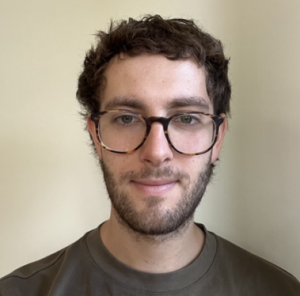
Harrison Greven
Adelaide University
I am a masters student in mathematics at the University of Adelaide, where I am supervised by Thomas Leistner and Mike Eastwood. Broadly speaking I am most interested in differential geometry in all its guises, although I’m yet to find an area of math that hasn’t excited me. My path to mathematics has had many detours. I originally studied computer science, then philosophy, before finding myself a student in mathematics. Although my initial intention in studying math had been to learn statistics, after a course in real analysis I quickly found myself enamoured with pure math. Due to this background, I am fascinated by the interplay between math and philosophy. Outside of math I enjoy running, am an avid basketball fan, and can often be found outdoors hiking, camping, and generally enjoying the sun.
Give me a quick overview of the type of mathematics you are studying, and/or the aims of your research and its potential applications/outcomes (how you would explain your work and studies to friends who don’t study maths?)
I study conformal differential geometry. In differential geometry, we study manifolds: objects that when we zoom in to small patches appear to resemble Euclidean space closely enough that we can take our familiar calculus and transfer it onto the manifold. Think of how the earth is a sphere, but very close it appears flat. Taking a manifold, if we add a metric (way of smoothly measuring distances and angles), we end up with what is called a (semi)-Riemannian manifold. In conformal geometry, we forget about the notion of length and focus only on angles and the ratios of lengths between vectors on the manifold.
The other objects I look at are Einstein manifolds, which can be thought of as a nice generalisation of manifolds that have constant curvature. The goal of my research is to study the question: If we have two manifolds that are in some sense “conformally” the same and one of them is an Einstein manifold, under what conditions is the other also Einstein?
How did you get into the mathematical sciences? Was there someone or something that inspired you to this field?
I almost never fell into mathematics. The first university level course I took in math I only narrowly passed. Some years later, I had decided I wanted to learn statistics, but on a whim, was convinced by a friend to try out abstract algebra and real analysis. These classes instantly scratched an itch in my brain and I’ve not looked back since.
Winter School is designed to give students a deeper understanding of their area of research and expose them to others working in different fields/industries. Tell me about your Winter School experience. What was the most valuable part of the program for you?
Winter school was excellent! Compared with regular subjects I’d taken at university or say the AMSI summer school, the winter school courses were much closer to research level content. But more than anything, the most valuable part were the informal conversations with others about their areas of research, and how they thought about different problems that I found most valuable.
What was your main take away/s from AMSI Winter School? Something you learnt? A connection you made? Do you have new ideas for your work/research or see it in a new light?
For me, the winter school was helpful in getting a taste for adjacent research areas. As I near the end of my masters I’m trying to decide on which areas I might like to do my PhD in. My main take away was that it has opened my mind up to new areas of research I hadn’t previously considered as a potential research area.
What surprised you most about Winter School?
I think how collaborative it all felt. Speaking with all these incredibly intelligent people all studying similar subject matter to me was something I haven’t before experienced, and it was quite cool.
What is the importance of in-person communication at an event like Winter School?
I think more so than the lectures themselves, the opportunities to speak both with experts in their fields, as well as fellow students and academics, is something that can’t be simulated over a screen.
You received a grant to attend AMSI Winter School. How important was this in terms of your ability to attend, fully participate in the program and meet others studying in similar fields?
As a student, there is almost no chance I would have been able to self-fund my trip to the AMSI Winter school. The grant was incredibly generous of AMSI, and had a big impact on my time there.
What advice would you give to someone who is considering applying for Winter School? How would you describe the conference to them?
I think it can be intimidating throwing yourself into an event like this, but once you’re there you’ll have such a great time. I think in those jam-packed two weeks I learnt more mathematics than I had in the 6 months leading up to it!
Tell us about a moment that changed a preconceived idea about your field?
I think the entirety of the course on the “Geometry of Einstein metrics”. Einstein metrics are something I study a lot in my research, but the point of view presented in these lectures was wholly different from the one I’d become familiar with. It was incredibly cool to be able to see them from this alternative view-point.
Where do you want the mathematical sciences to take you? Where do you see yourself in five, ten years time?
Right now I’m mostly just focused on getting into a good PhD program. In the long term I just hope I can continue studying and thinking about mathematics.
Any other feedback/comments you would like to provide on the travel grant or AMSI Winter School?
I had such a great time at the winter school, thank you so much to all the organisers and lecturers for organising!