
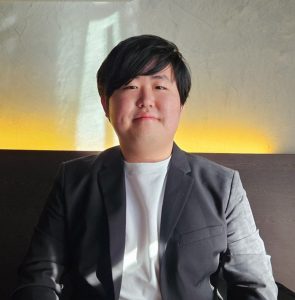
Donald Cheung
University of Sydney
Don is a Master of Mathematical Sciences student at the University of Sydney. He has also completed his undergraduate studies at the University of Sydney with a major in maths and is now continuing his studies through to the masters. Don has also completed a 1-year exchange program at Yonsei University, South Korea. His specialisation is in applied mathematics and is particularly interested in numerical methods and mathematical modelling to describe hidden physical phenomena in nature.
Give me a quick overview of the type of mathematics you are studying, and/or the aims of your research and its potential applications/outcomes
I’m currently using machine learning methods to develop fast and effective ways of forecasting chaotic dynamical systems. Although AI is everywhere these days, at a base level I see machine learning (a specific field of AI) as a bunch of linear algebra and probability, and then making the computer do all the work and seeing the magic happen! Chaotic dynamical systems are deterministic, however are extremely sensitive to initial conditions. This means that a very tiny change in initial conditions can lead to very different states later. The butterfly effect is perhaps the most famous way to describe this, i.e. a butterfly flapping its wings can create a tornado far away. It’s the theoretical foundation of well-known physical behaviour such as weather systems, fluid flow and planet motion just to name a few.
How did you get into the mathematical sciences? Was there someone or something that inspired you to this field?
I always enjoyed maths throughout school and choosing to study maths was the obvious choice for me. I wasn’t too sure if I would be continuing to study applied maths at a deep level until my master’s degree. My master’s studies really inspired me to this field and motivated me to continue my studies even further!
You received a grant to attend AMSI Summer School. How important was this in terms of your ability to attend, fully participate in the program and meet others studying in similar fields?
Along with many of my peers, fully participating in the program in person was vital to get the most out of AMSI Summer School. Although you will still participate in classes online, I think it’s what happens outside on campus and the people I met that made Summer School a unique experience.
What was the most valuable part of the program for you?
The best part of Summer School was meeting new people from all over Australia, all over the world and even meeting fellow students at your home university that you’ve met for the first time. One of the greatest times of my life was going on overseas exchange, and I was glad that I was able to re-live that experience again by immersing myself in a different academic environment.
In the long-term, what do you think are the benefits of having attended Summer School?
Summer School opened my perspective on academic life as a maths student and I realised that we were all brought into maths from all different kinds of environments. Of course, students will face many joys and struggles in their maths career, and it was great to meet with others who would share these similar experiences. I think it’s this broadened perspective that will carry with me throughout my studies and throughout my future maths career.
Summer School included a special Careers Day program which aims to help give students an idea of the kinds of career paths available to maths graduates in industry and private sector research areas. Do you feel better equipped to explore career options in the mathematical sciences after attending AMSI Summer School?
Yes, I feel that the Careers Day reinforced my understanding of the wide applications of maths. Especially with mathematical modelling, I’m optimistic that there’s a whole heap of fascinating problems to solve out there.
What advice would you give to someone who is considering applying for Summer School in 2027? Should they apply and why?
Definitely go for it and also make the best of the 4 weeks exploring a different city! My advice is to just be open to new experiences and prepare ahead by checking out the AMSI website or even talking to previous students who have also been to an AMSI program.
What are your current career ambitions in the mathematical sciences sector?
My current ambitions are leveraging mathematical modelling and using maths to uncover further mysteries in nature that would be very difficult to describe without the mathematics. I’m highly interested in pursuing a PhD and contribute towards science. In the future, I’m open to applying my maths skills into a wide variety of fields whether it’s academia or industry.
How did connecting with the community at AMSI Summer School support your experience?
I had an amazing time meeting and collaborating with new students and academics in various projects, such as image classification using neural networks. Moreover, I found out about AMSI before from friends who had participated in AMSI before, and they all had great experiences. I’m glad that I’m part of the wider AMSI community and I’ll definitely look back to my Summer School experience fondly.
Any other feedback/comments you would like to provide on the AMSI Travel Grant or AMSI Summer School 2026?
I want to thank all the organisers, students and everyone else involved in making the 4-week event happen! I’m highly grateful for the support through the AMSI Travel Grant and I hope this opportunity is available to future aspiring maths students.