
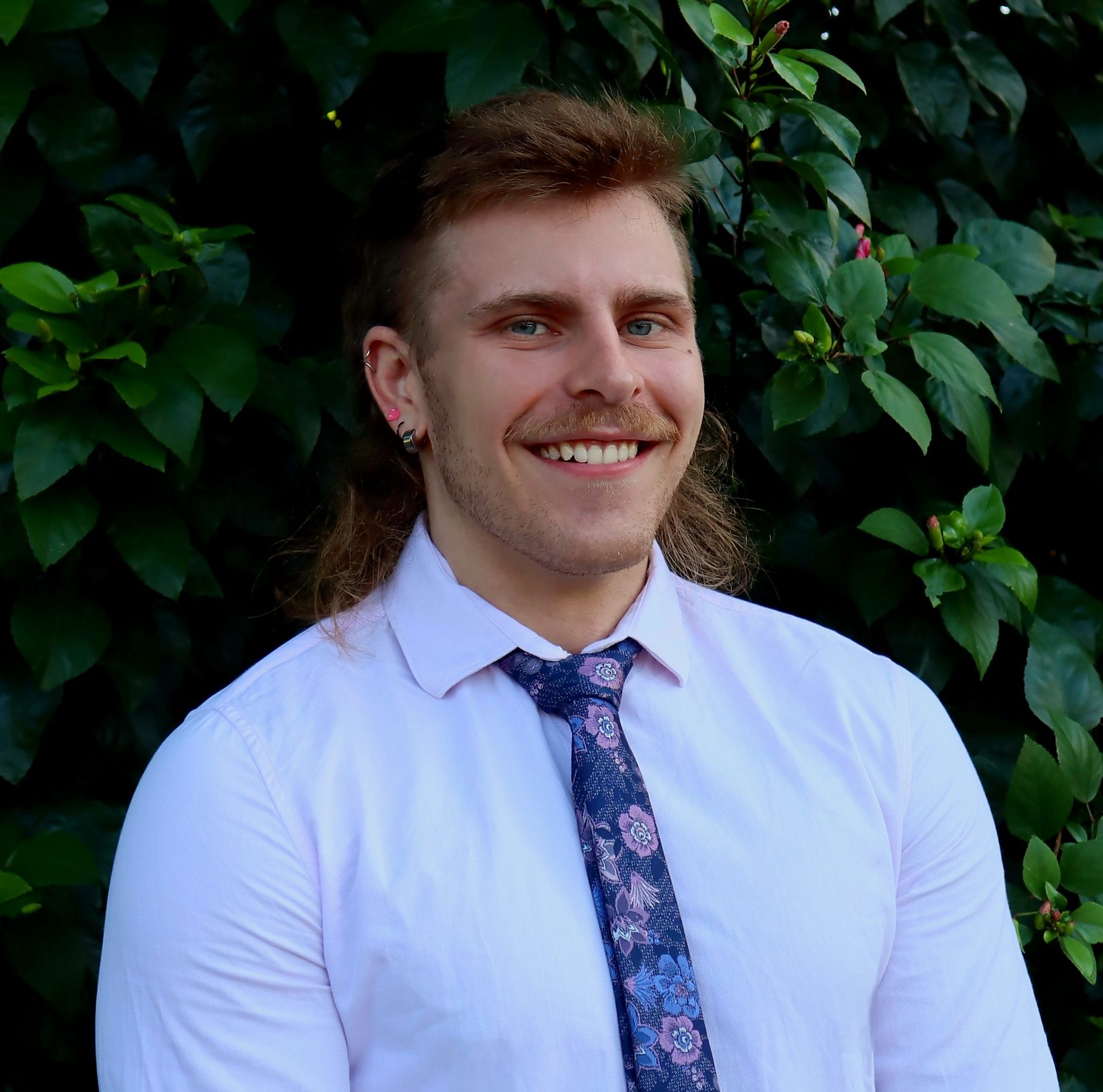
Llewyn Randall
Griffith University
I am a PhD candidate at Griffith University, Brisbane. My research primarily focuses on the fluid dynamics of systems which are being actively eroded. This presents some highly interesting problems to solve, and I get to make use of both analytic and numerical techniques. My background is in applied mathematics, but aspects of pure mathematics hold a place in my heart, and I endeavour to make use of proof techniques within my research. I am currently interested in how the fractal geometry of gullies influence their dynamics and how this could potentially be used to justify the use of one model over another. I also enjoy optimisation and would like to investigate how certain intervention strategies can be used to stabilise gully networks which are too large to tackle pervasively. I am no stranger to field work, which is something other mathematicians seldom get to experience. I am an avid hiker and rock climber and relish the opportunity to get outdoors and visit the mine sites or gullies networks throughout Queensland.
Can you give me a quick rundown about the type of mathematics you are studying and its potential impacts for the broader community (think how you would explain your work and studies to others who don’t study maths)
I model the erosion of large amphitheatre gullies. I make use of a variety of mathematical techniques to explore how water and sediment move within gullies and how that contributes to their growth and destabilisation of the landscape.
How did you get into mathematics/statistics/data science? Was there someone or something that inspired you to this field?
My undergraduate degree was mainly focused on wildlife biology and biochemistry. I made a last-minute decision to switch to the mathematics major and met my current supervisor, Dr Melanie Roberts, in a second-year linear algebra course. Her career has given her the chance to work in a diversity of fields and applications and this inspired me to pursue mathematics so I can accommodate my broader scientific interests.
You received a Travel Grant to attend AMSI Summer School 2025. How important was this in terms of your ability to attend, fully participate in the program and meet others studying in similar fields? Do you think it was an advantage to attend the program in-person?
Attending the program in person, on a student budget, was only achievable with the Travel Grant provided by AMSI. Mathematics is a subject best learned through in-person engagement in lectures and study groups around a whiteboard. The subject I took was quite difficult and I could not have possibly performed as well as I have without my peers.
What was the most valuable part of the program for you?
Being able to take a subject that I could not otherwise access through my home university is very beneficial. It has contributed to my research and continued to develop my skills as a mathematician in my PhD which does not otherwise have an associated coursework component.
In the long-term, what do you think are the benefits of having attended Summer School?
The Summer School helps us broaden our networks beyond our home universities with students of similar interests. For many of us, these are the colleagues we will work alongside for the decades to come.
Summer School included a special Careers Day program which aims to help give students an idea of the kinds of career paths available to maths graduates in industry and private sector research areas. Do you feel better equipped to explore career options in the mathematical sciences after attending AMSI Summer School?
The careers day included a few very interesting presentations. It was good to see the variety of careers available to mathematicians. There was a particular focus on the soft skills that we possess such as our coding and problem-solving abilities. I particularly enjoyed seeing Eddie Woo’s presentation from the NSW Department of Education. It is the passion for mathematics that him and teachers like him share that inspires many of us.
What advice would you give to someone who is considering applying for Summer School in 2026? Should they apply and why?
I would highly recommend applying for the 2026 AMSI Summer School. It is a great opportunity to build you network and learn from some very talented and engaging lecturers. My recommendations would be to stay on top of the workload. Do your best to complete problems as they are assigned, learn from your peers and create a study group chat. You will find these resources will continue to be used even following your time at the Summer School.
What are your current career ambitions in the mathematical sciences sector?
I was inspired by the Opening Ceremony talk given by Professor Nalini Joshi. I aspire to take my career overseas and work in the intersection of pure and applied mathematics, developing tools to solve the integrable systems that arise in nature.
How did connecting with the community at AMSI Summer School support your experience?
Our lecturer, Professor Enrico Valdinoci, was recommended to me from a past student. He was very engaging and an expert on the topics we were learning. I’m glad that the greater AMSI Summer School community was able to direct me towards his class. I feel that the connections I formed with other students helped to work through the challenging subject.
Any other feedback/comments you would like to provide on the AMSI Travel Grant or AMSI Summer School 2025?
I mainly just want to thank the AMSI Summer School coordinators for providing an engaging and supportive program. I will definitely be making effort to attend in future years.