
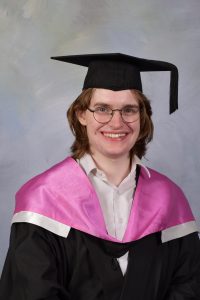
Thomas Newman
University of Western Australia
Thomas Newman is an honours mathematics student, who obtained his Bachelor of Mathematics from
UWA in 2025, with a GPA of 7.0. His research currently focuses on mathematical models of bushfire
spread, and their relationship with the empirical models used in practice, which are obtained via
statistical methods.
He is passionate about mathematics teaching, and has been tutoring mathematics privately for the last
three years. In addition, he tutors for Trinity College on Hampden, as well as the Zen MathMind, a
private tutoring company started by his own tutor, Blake Sims. Thomas’ passion for mathematics
teaching comes from the desire to make mathematics accessible without the need to “dumb down” the
material. Core to his teaching style is the goal of making sure the student never hesitates to ask a
potentially “stupid” question. In particular, he has extensive experience tutoring students that have
ADHD, which he himself is diagnosed with.
He takes extensive notes when studying, primarily using the note-taking app Obsidian (his current
Obsidian vault sits at over 480k words). These notes are very deliberately written in an accessible,
explanatory style, which he finds benefits not only his own learning but his teaching of others.
Eventually, he aims to create a website from which these notes can be accessed for free.
Give me a quick overview of the type of mathematics you are studying, and/or the aims of your research and its potential applications/outcomes
Currently, I’m studying mathematical models for the spread of bushfires, especially the velocity of the fire’s “front”. This is of obvious importance in Australia, and due to global warming is only becoming more so.
In Australia, the models recommended by our government institutions are derived using statistical methods. I.e., we look at a large collection of past bushfires, and find a function that best matches it. This process is done separately for each of Australia’s different biomes, leading to different formulas being recommended in each case.
This is unsatisfying, especially to a mathematician, since the formulas aren’t being derived from common principles. This contrasts with the approach taken in the US, which attempts to model bushfire spread via classical physical theory. My focus is in studying the divergence between these approaches, and to see whether the empirical models used here can be seen as approximations obtained by more mathematically sound approaches.
How did you get into the mathematical sciences? Was there someone or something that inspired you to this field?
I’ve always been especially good at mathematics. However, due to issues with undiagnosed ADHD, I actually never finished high school, dropping out around year 9 (crazy to think of how far I’ve come!). Thankfully, I was diagnosed and properly medicated a few years later. With my newfound ability to focus, I started organically getting the motivation to study on my own. I wanted to learn something in the sciences (I wasn’t sure what), but I of course needed to brush up on my mathematics before I could do so. I read through a book called The Art of Problem Solving: Prealgebra, a book meant for young kids preparing to enter mathematics competitions. Very early into the book, I realised mathematics was my true calling. Something felt so right when I was studying it; I could focus on mathematics in a way I simply couldn’t on other topics.
My mother (who I owe the world to), suggested I get a mathematics tutor, and we eventually settled on Blake Sims, an algebraic topologist out of the University of Melbourne. Blake realised very early on how much potential I had, and under his tutoring my knowledge grew exponentially. Within 6 months we were doing complex analysis, and within a year we were reading Hatcher’s Algebraic Topology.
Blake described our later sessions as “more like doing mathematics together”. From that point, it was clear to me I needed to attend university to pursue my full potential.
You received a grant to attend AMSI Summer School. How important was this in terms of your ability to attend, fully participate in the program and meet others studying in similar fields?
The AMSI travel grant was essential for me to attend. Being a student from UWA, the cost of travel would have been prohibitively expensive otherwise.
When applying for the summer school, I was only ever interested in in-person participation. As far as I’m concerned, online learning provides virtually no benefit over learning directly from a textbook: you can’t (easily) ask questions of the lecturer, nor can you socialise with your peers. The real benefit of in-person classes is the incredible networking opportunities provided, and the ability to learn from the lecturer outside of class. That last point is especially underappreciated; lecturers will go to great lengths to make time for students who show enthusiasm for their course, and this time is as valuable, if not more so, than the classes themselves.
What was the most valuable part of the program for you?
The ability to meet and network with the lecturers for my units. Especially Yann Bernard, who was a fantastic teacher and fed my curiosity at every turn. Also incredibly funny.
In the long-term, what do you think are the benefits of having attended Summer School?
The connections made with my peers and teachers. Each one of them is a potential collaborator for future research, and everyone I met during the summer school was brilliant in their own way.
Summer School included a special Careers Day program which aims to help give students an idea of the kinds of career paths available to maths graduates in industry and private sector research areas. Do you feel better equipped to explore career options in the mathematical sciences after attending AMSI Summer School?
Absolutely. I very much “value-maxxed” my time at the careers fair; I talked to every group there, filled about two and a half bags with merchandise, and made more contacts than I could reasonably list. The careers fair provided a diverse sample of the types of careers available to mathematics graduates, which I am incredibly grateful for.
What advice would you give to someone who is considering applying for Summer School in 2027? Should they apply and why?
If you’re wanting to attend, do it in-person. Ultimately, the unique value proposition provided by the summer school is the ability to network outside of your university. Certainly, the program carries some very interesting units, but the content alone could be learned from a textbook in most cases. In contrast, the connections you can make during the summer school may not be easily formed anywhere else.
What are your current career ambitions in the mathematical sciences sector?
I want to get a PhD. Maybe someday a Fields Medal, if I work hard, and get very lucky.
How did connecting with the community at AMSI Summer School support your experience?
I learned so much more that I would have otherwise by talking with my lecturers after class.
Any other feedback/comments you would like to provide on the AMSI Travel Grant or AMSI Summer School 2026?
From the bottom of my heart, thank you so much to everyone at AMSI who makes the summer school possible. This program, and in particular the grant, gave me an experience I would never have been able to have otherwise.